Available recordings
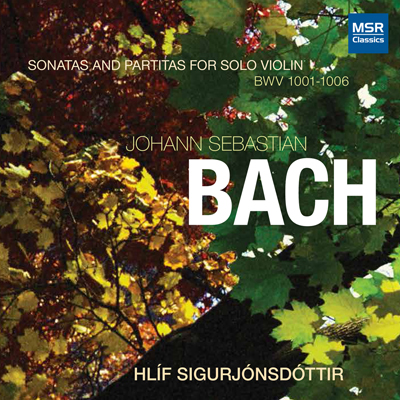
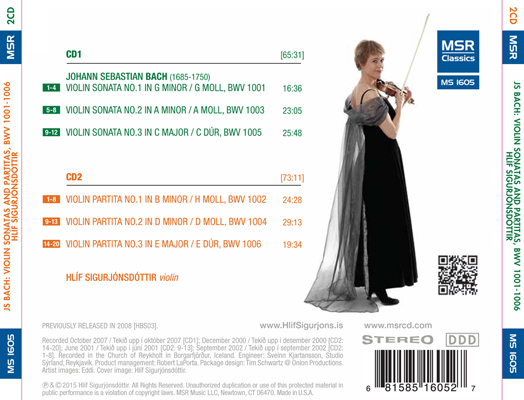
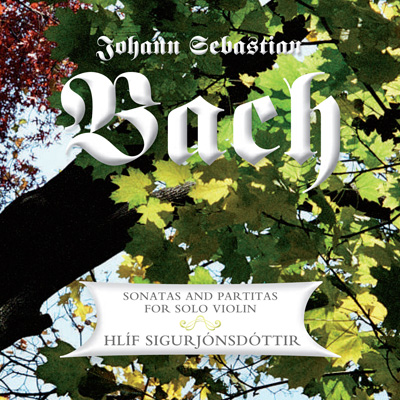
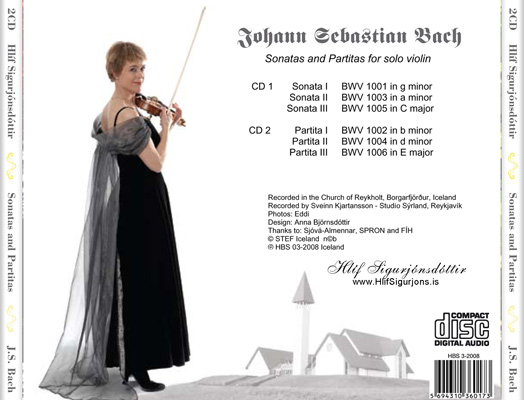
Johann Sebastian BACH
Sonatas and Partitas for Solo Violin, BWV 1001−1006
Hlíf Sigurjónsdóttir solo violin
Time: 66 and 73 minutes
Recorded by Sveinn Kjartansson in Reykholt's Church West-Iceland.
Publisher and distributor: MSR Classics
Also available at: Amazon
Previously released in Iceland in 2008 (as HBS03)
Sample: Gavotte en Rondo from Partita III, in E major
Reviews:
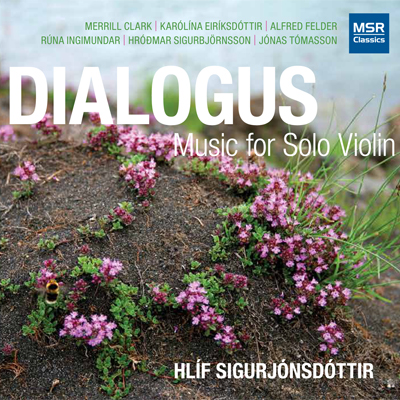
DIALOGUS
Hlíf Sigurjónsdóttir plays solo violin works by her friends who all are prominent composers.
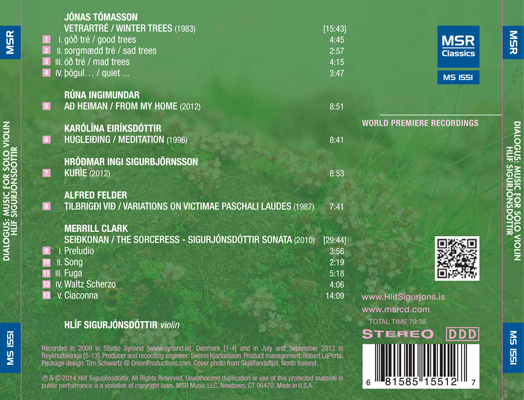
Time: 79 minutes
Recorded by Sveinn Kjartansson in Reykholt's Church West-Iceland.
Publisher and distributor: MSR Classics
Available at: Amazon
Sample: Kurìe by Hróðmar Inga Sigurbjörnsson
List of works: Winter Trees by Jónas Tómasson (1983), From my Home by Rúna Ingimundar (2012), Meditation by Karólína Eiríksdóttir (1996), Kurìe by Hróðmar Ingi Sigurbjörnsson (2012), Variations on Victimae Paschali Laudes by Alfred Felder (1987) and The Sorceress - Sigurjónsdóttir Sonata by Merrill Clark (2010).
Reference:
„I listened to the master, and fell under a magic spell. I was sorry when it was over. Really, I was taken somewhere“
Robert LaPorta, Director MSRClassics.
Reviews:
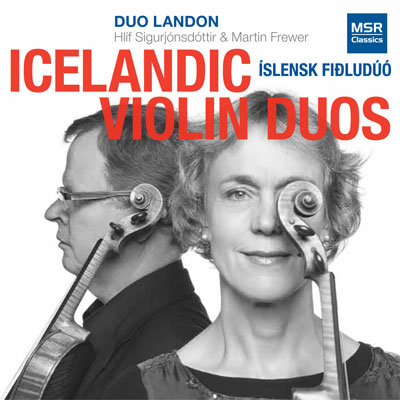
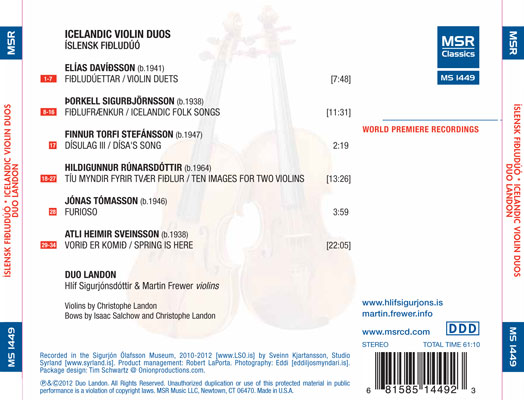
Icelandic Violin Duos by Elías Davíðsson, Þorkell Sigurbjörnsson, Finnur Torfi Stefánsson, Hildigunnur Rúnarsdóttir, Jónas Tómasson and Atli Heimir Sveinsson. Performers: Duo Landon: Hlíf Sigurjónsdóttir and Martin Frewer.
61 minutes
Publisher and distributor: MSR Classics
Also available at: Arkivmusic.com
Upon the very favourable reception of the CD with the 44 Duos by Béla Bartók, Duo Landon searched for some Icelandic violin duos to perform. While only three Icelandic violin duos were found in the files of the Iceland Music Information Center, the Duo commissioned violin duos from other three Icelandic composers. All these violin duos are found on this disc.
From reviewers:
"I loved the clarity of the sound on this disc and I recommend it to lovers of folk music and nature lovers who, like me, have enjoyed a visit to that fascinating island in the far north."
Maria Nockin, Fanfare [Issue 37:1, Sept/Oct 2013]
".. and find Porkell Sigurbjörnsson’s settings of Icelandic folk songs beautiful and evocative. Each very short piece captures the spirit of its title, particularly ‘Homeless in the Wilderness’, ‘Fall is Near’, and ‘Evening’; and the writing for two violins is wonderfully idiomatic. Sigurbjörnsson wrote these for his violin-playing granddaughters... There is a lot of creative and expressive music making here."
AMERICAN RECORD GUIDE SEPTEMBER/OCTOBER 2013
This CD was selected as a Pick of the month in July 2013 by CD HotList - classics: "Duo Landon (violinists Hlíf Sigurjónsdottir and Martin Frewer) play brilliantly and sensitively throughout".
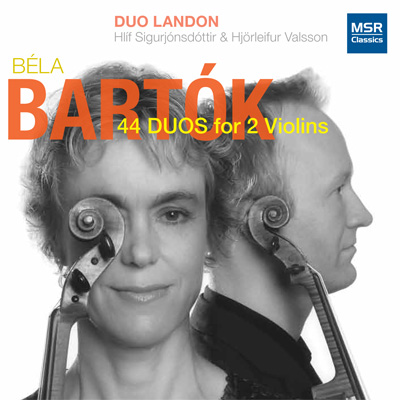
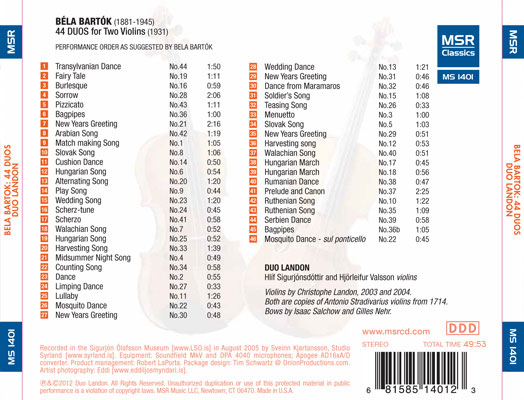
Re-released of HBS02 with Béla Bartók's 44 Violin Duos
Publisher and distributor: MSR Classics USA.
Also available at: Arkivmusic.com
From reviewers:
Sigurjónsdóttir and Valsson are fine artists who play with great style and accuracy. Their attention to detail helps to unveil the composer’s limitless imagination and his ability to write in the historic styles of Central and Eastern European ethnic groups. The sound, recorded in 2005, is full and rich. The dynamic range is wide and makes this is a good disc for those with excellent sound systems who do not have to worry about close neighbors.… it is valuable to hear the pieces played in the order preferred for the concert stage by the composer. Sigurjónsdóttir and Valsson play them brilliantly.
Duo Landon performs Béla Bartók’s 44 Duos for 2 violins with great talent and clear interpretation... Despite the short length of each piece the musical themes are clearly attainable to the listener through Duo Landon’s precise articulations and attention to expressive detail. Between the two violinists there is an impressive balance between the performances of the basic and more difficult pieces leaving the listener with a sense of ease and satisfaction. Listeners looking for a variety of musical styles and techniques will thoroughly enjoy Duo Landon’s interpretation of Bartók’s 44 Duos.
WHQR 91.3 FM April 27th 2012
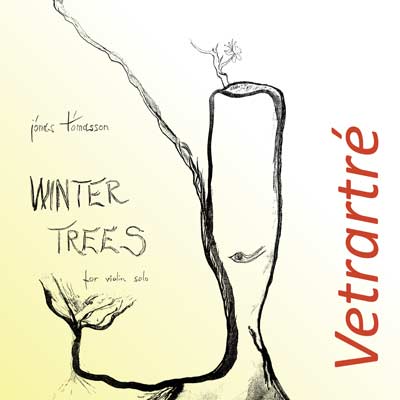
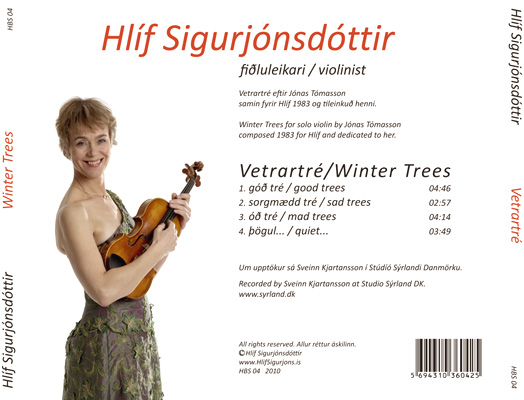
A CD with one work: Winter Trees, by Jónas Tómasson. Recorded in Denmark in May 2009 in the new studio of Stúdíó Sýrland in Jutland. Limited edition.
18 minutes
Booklet - PDF
Limited number
Price USD 10
Johann Sebastian Bach was born in Eisenach in 1685, and at the age of 10, after the death of both his parents, he went to live with his oldest brother, Johann Christoph, who was an organist at Ohrdruf.
After working as an organist and court musician, Johann Sebastian was appointed to the court of Margrave Wilhelm Ernst of Weimar in 1708. Six years later he became the concertmaster of the court. In 1717 he left Weimar for the court of Prince Leopold of Anhalt-Cöthen, where he remained until 1723. He then went to Leipzig, where he lived and worked until his death in 1750. In Leipzig Bach was the cantor at the church of St. Thomas and from 1729 also the director of the Collegium Musicum, which had been founded in 1702 by Telemann.
At Weimar, Bach was employed as an organist, and he wrote many of his organ works during this period. He achieved renown as a virtuoso organist. In Cöthen, on the other hand, he had no ecclesiastical duties, but was responsible for all the music performed at the court. At this time he composed many pieces for a variety of instruments. In Leipzig he composed both devotional and secular works.
Bach composed the six solo violin works - three sonatas and three partitas - in Cöthen in 1720, when he was 35 years old. He based them upon the rich traditions of the German violin school. It has been suggested that he may have composed them as studies, as Paganini later did with his 24 Caprices. It is very clear that Bach was thoroughly familiar with the violin, and his fertile imagination discerned previously unknown potential in the instrument and its music.
"I have been familiar with these compositions since I began studying the violin at an early age with the concertmaster of the Iceland Symphony Orchestra, Björn Ólafsson. He saw these compositions as the violinist´s Bible, and I was fortunate enough to play them all under his guidance. Ólafsson's tutor had been Adolf Busch.
My last teacher, Gerald Beal, has left his mark on my artistic approach as well with his inventive fingering solutions and a clear musical approach. His teacher was Jascha Heifetz."
June 2008 - Hlíf Sigurjónsdóttir
Reviews:
Booklet - PDF
Sold out, see new release
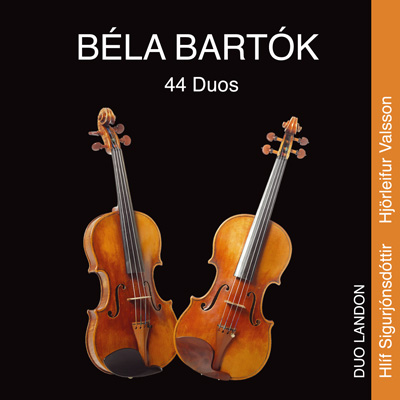
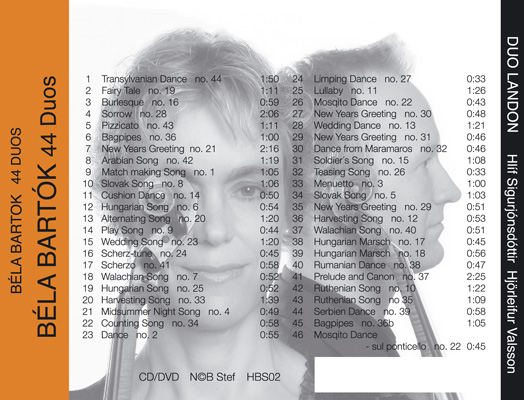
Hlíf Sigurjónsdóttir and Hjörleifur Valsson "Béla Bartók, 44 Duos"
The new CD of Béla Bartók's "44 Duos" is an exemplary one. Without exception the artists capture the composer's limitless imagination in recreating Hungarian and other Central European historic styles. Perhaps most evident is the heartening way Bartók's rhythmic vitality is made accessible to the listener, an accomplishment requiring precise articulation, the delineation of phrase structure, and a secure sense of the music's interior metrical pulse.
In addition, Bartók's marvelous variety of styles is conveyed by the élan of the performers. Everything is here - dark, somber folk melodies, spritely dances, childlike moments (suiting the music´s underlying pedagogical intent), graceful imitative lines, and a strong sense of improvisation.
The Duos are brief micro-moments but bare a musical soul that is rich, deep, and long-lived. This recording should be at the top of the list for 2006 and beyond.
Cecelia Porter Classical Music Critic, The Washington Post
Béla Bartók (1881-1945) was one of Hungary´s leading composers. He was also an ardent collector of folk music from his own country and of neighbour countries such as Transylvania, Slovenia, Serbia, Rumania, Ukrainie and even Arabia. This music became a part of his own musical language. The 44 Duos were put together by Béla Bartók in the years 1930 - 1932, on commission from the German Violin Pedagogue Erich Doflein, who intended those as teaching material. All of the numbers of the 44 Duos stem from Bartók´s folk music collection except for number 36a/b, which are his original compositions. Those short pieces tell a story of everyday life, joys and sorrows. They take the player and the listener on a journey through those different countries with their different climates, customs and temperaments of their people.
Duo Landon, Hlíf Sigurjónsdóttir and Hjörleifur Valsson performed these 44 Duos at 2005 summer concert series in the Sigurjón Ólafsson Museum. A week later they recorded them in the same hall on commissioin by their violin maker Christophe Landon.
Sold out, see new release